An Indian company’s Form FC-GPR is usually rejected by its bank for one of a small set of reasons: a mismatch between the foreign inward remittance certificate (FIRC), the KYC report and the form; a valuation certificate that does not meet the pricing rules; wrong share data; missing attachments; or a delay filed without a Late Submission Fee. Almost all of them can be fixed and the form resubmitted, but each round of rejection costs time, and the clock on the 30-day reporting window and any Late Submission Fee keeps running.
This guide explains why Authorised Dealer (AD) banks reject FC-GPR filings on the RBI’s FIRMS portal, the most common observations, and how to correct each one. It also covers the Late Submission Fee, what to do after a rejection, and a pre-filing checklist you can use before you press submit.
Quick answer: what to do first when your bank rejects FC-GPR
- Read the bank’s remark word for word and note which field or document it points to.
- Check it against the FIRC, KYC report, valuation certificate, board resolution and Form PAS-3, because most rejections are a mismatch between these.
- Check whether the filing is already late. If it is, a Late Submission Fee application comes first.
- Correct every item in one go, then resubmit, rather than fixing one remark at a time.
- Keep a written record of what the bank asked and what you changed.
What FC-GPR is and how the filing works
Form FC-GPR is the report an Indian company files with the Reserve Bank of India after it issues equity instruments to a person resident outside India under the Foreign Exchange Management (Non-Debt Instruments) Rules, 2019. It covers equity shares, compulsorily convertible preference shares (CCPS), compulsorily convertible debentures (CCD) and similar instruments issued against foreign investment.
The filing is made online on the RBI’s FIRMS portal through the Single Master Form (SMF), and it is routed through the company’s AD Category-I bank. In practice:
- The company registers on FIRMS as an entity, and its authorised signatory registers as a business user, which the AD bank verifies.
- The company files the form with the investor, instrument and pricing details, and uploads supporting documents.
- The AD bank checks the form and the documents. If they are in order, the bank forwards the form to the RBI. If not, the bank returns or rejects it with remarks.
- The RBI then takes the form on record, or may raise further clarifications, which are routed back through the AD bank.
The timelines that matter
- Shares generally have to be allotted within 60 days of receiving the foreign investment, failing which the money has to be refunded.
- FC-GPR must be filed within 30 days of the allotment.
- A filing after that period is a delayed filing. It can be regularised only by paying a Late Submission Fee (covered below).
The RBI’s Master Direction on Foreign Investment in India, updated in January 2025, also makes the AD Category-I bank the first point of contact for clarification requests on foreign investment. The practical effect is simple: whatever the bank sees on the portal, and whatever the RBI later asks, reaches you through the bank. A clean first filing therefore saves far more than the time of one resubmission.
How the AD bank reviews an FC-GPR filing
The bank is not checking whether the investment is a good one. It is checking that the form, the documents and the underlying transaction tell the same story, and that the issue complies with the entry route, sectoral cap and pricing rules. Under the Master Direction, the responsibility for meeting sectoral caps and conditions stays with the company receiving the investment, so the bank will look for evidence rather than take the form at face value.
A typical review covers:
- Remittance: the FIRC or the bank’s certificate of credit against the investor’s name, amount and date.
- Investor identity: the KYC report on the non-resident investor, issued by the remitting bank.
- Pricing: the valuation certificate and whether the issue price is at or above fair value.
- Corporate approvals: the board or shareholder resolution, the allotment records and the Company Secretary’s certificate.
- Data on the form: number and class of securities, face value, premium, total consideration and the pre- and post-allotment shareholding in the Entity Master.
- Timing: the allotment date, the date of receipt of funds and the filing date.
If any one of these does not line up with another, the form comes back. That is why the corrections below are mostly about reconciliation rather than about new paperwork.
Common reasons an FC-GPR is rejected, and how to correct each one
The observations below are the ones most often reported by practitioners. The wording on the portal varies from bank to bank, so match the substance of your remark to the nearest item.
1. Valuation certificate does not meet the pricing rules
Under the Master Direction, shares issued to non-residents by an unlisted company must be priced at or above fair value, determined by an internationally accepted pricing methodology and certified by a Chartered Accountant, a SEBI-registered Merchant Banker or a practising Cost Accountant. The certificate must not be more than 90 days old on the date of the investment.
Typical bank remarks and the correction:
- Certified by an unauthorised person. Obtain a fresh certificate from one of the professionals listed above.
- No methodology stated. Ask the valuer to reissue the report naming the method used, for example discounted cash flow or net asset value.
- Valuation date too far from the allotment date. Get an updated valuation, or confirm the certificate is within the permitted period for the date of investment.
- Issue price below the certified fair value. The pricing rule is a floor. Either the issue price must be revised in line with the rules or the transaction terms must change.
- CCPS or CCD with no conversion formula. The certificate must state the conversion ratio or formula, because the pricing of a convertible instrument is fixed by its conversion terms.
2. FIRC and FC-GPR details do not match
This is one of the most frequent reasons for return. The bank compares the form against the FIRC line by line.
- Investor name differs. Enter the name exactly as it appears on the FIRC.
- Wrong exchange rate or date. The INR amount should reflect the rate and date on the FIRC, not the date the form was filled in.
- Amount or remittance date differs. Correct the form to the FIRC. If a part of the money came through more than one remittance, show each one.
3. KYC report is missing, old or incomplete
The KYC on the non-resident investor must come from the overseas remitting bank and be routed through the Indian AD bank. A self-declaration by the investor is not a substitute.
- KYC dated well outside the transaction window. Obtain a current report.
- Missing remitter account number, SWIFT code or bank details. Ask the remitting bank for a complete report.
- KYC is in the parent’s name, but shares go to a subsidiary or SPV. Provide a linking declaration, or obtain KYC on the actual allottee.
- Remitter and allottee are different entities. Provide a declaration of the relationship, the approval for the structure, and confirmation that the ultimate beneficial owner is consistent across the FIRC, KYC and share certificate.
4. Wrong instrument type
Reporting the instrument incorrectly is a common slip, and it matters because pricing and reporting differ by instrument.
- CCPS reported as equity shares, or CCD reported as CCPS: correct the instrument type.
- Shares issued on exercise of ESOPs reported as fresh foreign investment: report them under the correct category.
- Shares issued on conversion of a convertible note reported as a fresh subscription: correct the classification and, if asked, explain how the conversion was reported earlier.
5. Entity Master shows the wrong pre-allotment shareholding
The SMF pulls the existing shareholding from the company’s Entity Master. If earlier allotments, transfers or buybacks were never updated there, the pre-transaction holding on the new form will be wrong.
- Reconcile and correct the Entity Master first, through the AD bank.
- File the fresh SMF only after the Entity Master is correct. Doing both at the same time invites another return.
6. Numbers differ across the board resolution, PAS-3 and FC-GPR
The number of securities, their class and face value must be identical in the allotment resolution, Form PAS-3 filed with the Registrar of Companies, the share certificates and the FC-GPR. A gap such as 11,000 securities in the resolution, 12,000 in PAS-3 and 10,000 in the FC-GPR is a straightforward reason for return.
- Reconcile every document to one set of figures before anything is signed.
- If an MCA filing is wrong, correct that first, then the FC-GPR.
7. Face value, premium and issue price entered wrongly
A frequent data-entry error is to enter the face value as the issue price, or to leave the premium blank. Enter the face value, the premium per share and the total issue price separately and check that they match the MCA records and the resolution.
8. Missing or defective attachments
The documents usually expected with the form are:
- FIRC or the bank’s certificate of credit
- KYC report on the investor
- Board resolution approving the allotment
- Valuation certificate
- Company Secretary’s certificate in the prescribed format
- Declaration of the authorised representative
- PAS-3 acknowledgement and a pre- and post-allotment cap table, both strongly advisable
- Government approval, where the investment is under the government route
Common defects are scans that are illegible or unsigned, documents not self-certified, wrongly named files, and a Company Secretary’s certificate that is not in the prescribed format or is undated. Your bank may ask for more, so check its checklist before filing.
9. Entry route, sectoral cap or conditions not demonstrated
The bank must be satisfied that the sector allows foreign investment through the route used, that the cap is not exceeded after the allotment, and that any sector conditions, such as approvals, are met. If the declaration or the Company Secretary’s certificate is silent on this, expect a remark. Add the sector analysis, the post-issue foreign holding and, where needed, the government approval.
10. Delayed filing submitted without the Late Submission Fee
If the form is submitted after the 30-day window, the bank will not process it as a normal filing. Apply for the Late Submission Fee first, pay it, and then file. Do not change the allotment date or the filing date to hide the delay, because the dates will be tested against the FIRC and the MCA records.
11. Filed through the wrong AD bank or branch
If the remittance came through one bank but the form is filed through another, the new bank will not be able to see or verify the inward remittance. File through the AD bank that received the money, or complete a formal change of AD bank, with an explanation, before filing.
Late Submission Fee and what a delay costs
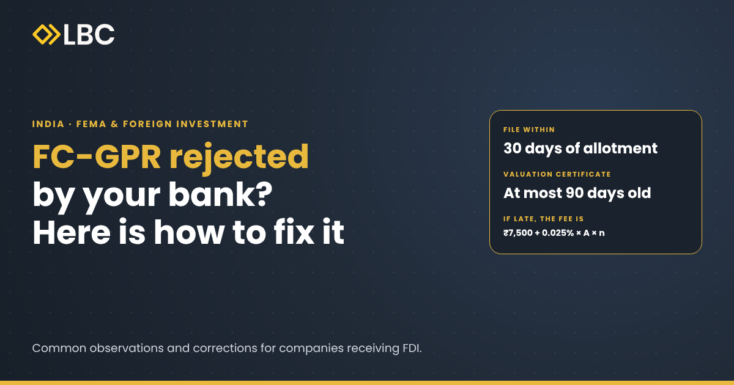
A delayed FC-GPR is regularised by paying a Late Submission Fee (LSF), under the RBI’s uniform LSF framework (circular RBI/2022-23/122, dated 30 September 2022). FC-GPR is a flow or transactional return, so it falls in the higher category:
LSF = ₹7,500 + (0.025% × A × n)
Here A is the amount involved in the delayed reporting and n is the delay in years, rounded up to the nearest month and shown to two decimal places. The fee cannot exceed 100% of A, rounded up to the nearest ₹100.
Worked examples
- Foreign investment of ₹1 crore reported 6 months late (n = 0.50): 0.025% × ₹1,00,00,000 × 0.50 = ₹1,250, so the LSF is ₹7,500 + ₹1,250 = ₹8,750.
- Foreign investment of ₹10 crore reported 15 months late (n = 1.25): 0.025% × ₹10,00,00,000 × 1.25 = ₹31,250, so the LSF is ₹7,500 + ₹31,250 = ₹38,750.
How the process works
- The LSF applies to each return that is filed late.
- The delay is counted up to the date the RBI receives the fresh LSF application.
- Once the RBI advises the amount, it has to be paid within 30 days. A later submission is not accepted.
- A company can opt for LSF up to three years from the due date of the report. Beyond that period, the contravention would generally have to be dealt with through compounding.
Why this matters when a bank rejects the form
If the first filing was on time but is then returned, correct and resubmit it promptly and keep proof of the date of the original submission. Some practitioners report that the exposure to an LSF keeps building until a correct filing is accepted, so ask your bank how it treats a form that has been returned, and do not let corrections drift. Continued or wilful non-reporting can also lead to adjudication or compounding proceedings under FEMA. The penalty provision, Section 13(1), allows a penalty of up to three times the amount involved.
A reported tribunal decision shows how seriously the process is taken. In Union of India v. Peritus Corporation Pvt. Ltd. (SAFEMA Appellate Tribunal), a case under the earlier 2000 regulations, a company that had filed its FC-GPR within the 30 days still faced adjudication because the RBI had not taken the form on record. The RBI’s clarification request had gone only to the bank, and the company said it did not know of it. The tribunal found a technical error and declined to enhance the penalty beyond the minimum. The lesson for a company is to keep asking the bank whether any query is pending until the RBI has accepted the filing.
Step by step: how to respond to a rejection and resubmit
- Capture the remark exactly. Take a screenshot or copy the text from FIRMS and note the date it was returned. If the remark is vague, ask the bank officer in writing which field or document is in question.
- Sort it into one of three types. A data error (a field that was entered wrongly), a document defect (a missing, unsigned or inconsistent paper) or a substantive issue (pricing, entry route or sectoral cap). Data errors are fixed in the form, document defects need new papers, and substantive issues may need advice before anything is refiled.
- Build a reconciliation sheet. Put the FIRC, KYC, valuation certificate, board resolution, PAS-3, share certificates and Entity Master side by side and compare the investor name, amount, dates, number of securities, face value, premium and price. Any difference is a likely cause of the return, even if the remark did not mention it.
- Check the timeline. Calculate the number of days from allotment to the original filing and to today. If the filing is late, deal with the Late Submission Fee first.
- Correct at source. If the error is in a company record, such as a PAS-3 or the Entity Master, correct that first, then update the FC-GPR. Correcting only the FC-GPR leaves the next review with the same mismatch.
- Fix everything at once. Resubmit only when every document and field has been checked, not just the one the bank mentioned. Repeated returns with new remarks each time are what make FC-GPR slow.
- Resubmit through the same AD bank and branch. Use the correct portal option for a returned form, attach the corrected documents, and add a short covering note listing what changed.
- Follow up until the RBI takes the form on record. Ask the bank in writing whether any query is pending, respond to clarifications quickly, and keep the acknowledgement.
FC-GPR pre-filing checklist
Assemble one transaction file before opening FIRMS, and run through this list before you submit.
Transaction and pricing
- Entry route and sectoral cap checked, and any government approval obtained
- Shares allotted within 60 days of receiving the funds
- Valuation certificate issued by an authorised professional, with the method stated and within 90 days of the investment date
- Issue price at or above fair value, with the conversion formula stated for CCPS or CCD
Remittance and investor
- Investor name, amount, date and exchange rate match the FIRC
- KYC report from the overseas remitting bank, routed through the AD bank, with complete account and SWIFT details
- Linking declaration if the remitter and allottee differ
Corporate records
- Board resolution, PAS-3, share certificates and FC-GPR show the same number, class and face value of securities
- Face value, premium and total issue price entered separately
- Entity Master shows the correct pre-allotment shareholding
Filing
- Company Secretary’s certificate in the prescribed format, signed and dated
- All attachments legible, signed, self-certified and correctly named
- Filing routed through the AD bank and branch that received the remittance
- Filing made within 30 days of allotment, or Late Submission Fee application made first
Frequently asked questions
What does it mean when the bank rejects an FC-GPR?
It means the AD bank has returned the form on FIRMS with remarks because something does not match or is missing. The form has not reached the RBI. You correct the points raised and resubmit.
Is a rejected FC-GPR treated as filed on time?
There is no safe assumption here. The original submission date is useful evidence of your good faith, so keep it, but a form that has been returned can still be treated as pending until a correct one is accepted. Ask your bank how it will treat the date, and resubmit quickly.
Who can certify the valuation for FC-GPR?
For an unlisted company, a Chartered Accountant, a SEBI-registered Merchant Banker or a practising Cost Accountant, applying an internationally accepted pricing methodology. The certificate must not be more than 90 days old on the date of the investment.
Can we file FC-GPR through any bank?
File through the AD Category-I bank where the company is registered on FIRMS, and which received the inward remittance. A different bank cannot verify the remittance, so change the AD bank formally first if you need to.
What is the Late Submission Fee for FC-GPR?
It is ₹7,500 plus 0.025% of the amount involved for each year of delay, with the delay rounded up to the nearest month, and the total capped at 100% of the amount involved. FC-GPR falls under the category of flow or transactional returns.
What happens if the RBI has not taken the FC-GPR on record?
The RBI may raise clarifications, which are routed through the AD bank. If they remain unanswered, the company can face adjudication or compounding under FEMA. Check with the bank regularly until the form is accepted.
Do we need a Company Secretary’s certificate?
Yes, a certificate from the company secretary, in the format prescribed for FC-GPR, is one of the documents the bank expects. It confirms compliance with the Companies Act, 2013, the NDI Rules and the articles of association.
Getting FC-GPR right the first time
An FC-GPR rejection is rarely a sign that the investment itself is wrong. It is nearly always a sign that the papers do not agree with each other. The fastest way to avoid it is to reconcile the FIRC, KYC, valuation, board resolution, PAS-3 and Entity Master before the form is filed, and to keep the 30-day window in view from the day of allotment.
How Lapras can help
Lapras Business Consultants works with companies receiving foreign investment, and with the overseas investors behind them. For FC-GPR we can:
- review your transaction file against the AD bank’s requirements before you file
- reconcile the FIRC, KYC, valuation, PAS-3 and Entity Master, and correct the Entity Master where needed
- respond to the bank’s observations and resubmit on FIRMS
- calculate and apply for the Late Submission Fee on delayed filings
- support you in regularising older filings, including compounding where it is needed
If your FC-GPR has been returned, or you are about to issue shares to a foreign investor, write to us at reachus@lapras.in or visit www.lapras.in.
This article is general information, not legal advice. Rules, forms and portal practices change, so confirm the current position with your AD bank and the RBI before you file.