
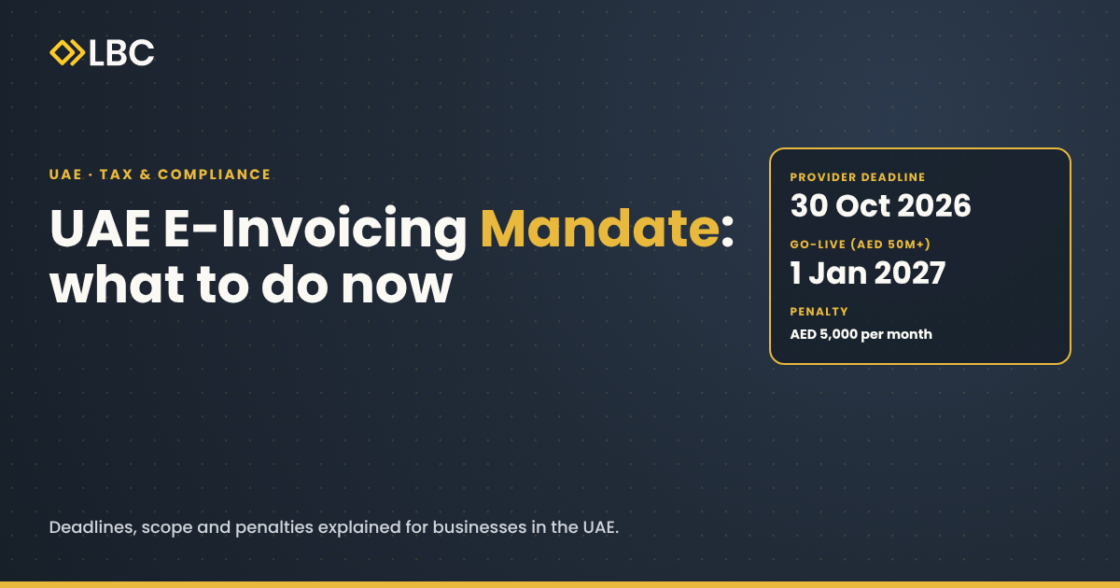
Your first deadline is 30 October 2026. 🇦🇪
What the UAE e-invoicing mandate is
From 1 January 2027, UAE businesses with revenue of AED 50 million or more must issue B2B and B2G invoices as structured electronic data through an accredited provider. Everyone else follows in 2027. The first deadline falls on 30 October 2026, when in-scope businesses must have appointed their provider.
The mandate is set by Ministerial Decisions 243 and 244 of 2025 under the Ministry of Finance’s Electronic Invoicing System, as amended by Ministerial Decisions 66 and 197 of 2026. A PDF or scanned invoice no longer counts as an e-invoice. The invoice must be a structured digital file that can be validated and exchanged automatically.
The five-corner model (DCTCE)
The UAE uses a Decentralised Continuous Transaction Controls and Exchange model with five parties:
- Corner 1: the supplier issues the invoice.
- Corner 2: the supplier’s accredited service provider (ASP) validates and sends it.
- Corner 3: the buyer’s accredited service provider receives it over the network.
- Corner 4: the buyer receives the invoice.
- Corner 5: the Federal Tax Authority receives the tax data from the providers.
Businesses never talk to the authority directly for each invoice. The accredited provider does that on their behalf, so choosing a provider is the key decision.
Why the UAE is introducing it
The mandate replaces PDF and paper invoices with structured data that systems can read without re-keying. For the authority, that means near-real-time visibility of B2B and B2G transactions and a stronger base for VAT and corporate tax compliance. For businesses, the practical gains are fewer manual entries and data errors, faster invoice exchange and matching, fewer payment disputes and cleaner audit trails. Those gains only arrive if your data and processes are ready, which is why early preparation matters.
Who is in scope and when
The mandate covers B2B and B2G transactions of VAT-registered businesses. Rollout is in waves by revenue, so the first step is to find your wave.
| Wave | Provider appointed by | Go-live |
| Voluntary pilot | n/a | From 1 July 2026 |
| Revenue AED 50M or more | 30 October 2026 | 1 January 2027 |
| Revenue below AED 50M | 31 March 2027 | 1 July 2027 |
| Government entities | 31 March 2027 | 1 October 2027 |
Revenue is measured on the basis the Ministerial Decisions set out, so confirm which year’s figures apply to you before you assume you fall in the lower wave. Confirm dates against the latest amendments, because Decisions 66 and 197 of 2026 changed parts of the original framework.
Businesses that are out of the B2B and B2G flow, such as pure consumer (B2C) sellers, are covered by separate treatment under the Decisions. Check your own position before you rely on an exclusion.
How it works in practice
Appoint an accredited service provider
Only providers accredited by the Ministry of Finance (under Ministerial Decision 168 of 2026) can transmit e-invoices. Shortlist providers on integration with your ERP or accounting system, support for your invoice volumes, security, and pricing. Sign the appointment and onboard through EmaraTax so the authority knows which provider acts for you.
The invoice flow
Your system creates the invoice in the required structured format. Your provider validates it and sends it across the network to the buyer’s provider, then reports the tax data to the authority. The buyer receives the invoice in their own system. Credit notes follow the same route.
What Decision 197 of 2026 changed
Decision 197 of 2026 relaxed parts of the earlier framework. Notably, it replaces the earlier UAE-only data storage requirement and the two-business-day system-failure notice described in the original guidelines. Always read the latest consolidated position before you design your process.
Timing
In-scope businesses must issue the e-invoice within 14 business days of the supply.
Invoice types, data fields and the technical standard
The standard: Peppol PINT AE
The UAE has adopted the Peppol International specification for the UAE (PINT AE), first published by the Ministry of Finance in June 2025. Invoices are XML files in this format and travel over the Peppol network between accredited providers. Your provider normally generates, validates and transmits the XML, so your own system needs to supply complete, correct data rather than build the file itself.
Document types covered
| Type code | Document |
| 380 | Commercial (tax) invoice |
| 480 | Invoice out of scope of tax |
| 381 | Credit note |
| 81 | Credit note for goods or services out of scope of tax |
| 389 | Self-billed invoice |
| 361 | Self-billed credit note |
What data you must capture
The Federal Tax Authority’s technical guidance lists 51 mandatory fields for an electronic tax invoice, in six groups:
- Invoice details: number, date, type code, currency, payment due date, payment means and transaction-type flags.
- Seller details: name, electronic address, the 0235 identifier, legal registration details, TRN or TIN, tax scheme and address.
- Buyer details: electronic address and identifier, name, TRN where applicable and address.
- Document totals: sum of line amounts, totals with and without tax, tax amount and amount payable.
- Tax breakdown: tax category code, rate, taxable amount and tax amount.
- Line level: line ID, quantity, unit of measure, price, tax category and rate, with AED equivalents.
Special transaction types must be flagged consistently. These include free trade zone supplies, deemed supply, the profit margin scheme, summary invoices, continuous supply, disclosed agent billing, e-commerce supply and exports.
The identifier: your TIN
Your Peppol participant ID is your Tax Identification Number (TIN), which is the first 10 digits of your corporate tax registration number. A business that does not need to register for corporate tax must still register with the Federal Tax Authority to get a TIN. Each group company needs its own TIN and its own Peppol endpoint.
Things that are not e-invoices
- B2C invoices are excluded until further notice.
- Imports are outside the obligation, because the Ministry cannot impose its format on foreign vendors.
- A PDF cannot be attached as the invoice copy. Attachments are limited to supporting documents such as work reports or certificates.
Your readiness checklist
- Check your wave. Work out which revenue band you fall in and note your provider deadline.
- Appoint your provider. Shortlist accredited providers and sign before your deadline (30 October 2026 for AED 50M and above).
- Map and clean your data. Make sure customer TRNs, addresses, tax codes and item details are complete and consistent in your ERP.
- Test voluntarily. The pilot has been open since 1 July 2026. Run real invoices through it before go-live.
- Go live. Switch on e-invoicing from 1 January 2027 if you are in the first wave.
- Issue every B2B and B2G invoice on time, within 14 business days.
- Keep records and stay ready. Retain invoices and logs in line with the retention rules and watch for further amendments.
A practical plan from now to go-live
| When | What to do | Who |
| Now to 30 Oct 2026 | Confirm your wave and sign with an accredited provider | Finance head, CFO |
| November 2026 | Map ERP and billing fields to the mandatory data. Clean customer and supplier master data, TINs and addresses | Finance and IT |
| November to December 2026 | Connect to your provider. Run test invoices, credit notes and special cases such as free zone and export supplies | IT and provider |
| December 2026 | Train accounts staff. Update invoicing, credit-note and dispute procedures. Agree how to handle system downtime | Finance operations |
| 1 January 2027 | Go live. Monitor rejections daily during the first weeks | Finance and IT |
Common mistakes to avoid
- Treating it as an IT project only. Tax, finance and sales teams own the data that feeds the invoice.
- Leaving master data until late. Missing TINs, wrong legal identifiers and address gaps are the most likely cause of rejected invoices.
- Choosing a provider on price alone. Check ERP integration, support during go-live, security and what happens when your invoice volumes grow.
- Ignoring special transactions. Free zone, export, margin scheme and deemed supply cases need the right flags.
- Forgetting group companies. Each entity needs its own TIN and endpoint.
Penalties and record keeping
Cabinet Decision No. 106 of 2025 sets the administrative penalties:
- AED 5,000 per month for failing to appoint an accredited service provider by the deadline.
- AED 100 per invoice for failing to issue an e-invoice, capped at AED 5,000 per calendar month.
These are in addition to normal VAT consequences. Keep e-invoices, credit notes and the related transmission records for the period required under the UAE tax laws, and make sure they can be produced on request.
How Lapras helps
Lapras Business Consultants supports businesses in the UAE through our partner desk and from our offices in India, the UK and the USA. We help you work out your wave, shortlist and appoint a provider, review your invoicing data, and plan a controlled go-live. Write to us at lapras.in to book a readiness review.
Frequently asked questions
Does e-invoicing apply to my business? If you are VAT-registered and make B2B or B2G supplies, yes, in the wave set by your revenue.
What is the next deadline? Businesses with revenue of AED 50M or more must appoint a provider by 30 October 2026.
Can I email a PDF invoice instead? Not for in-scope transactions once your go-live date arrives. The invoice must be structured data sent through the network.
What is the penalty for missing the deadline? AED 5,000 per month for not appointing a provider, and AED 100 per invoice, capped at AED 5,000 per month, for not issuing e-invoices.
Can I test before go-live? Yes. The voluntary pilot has been open since 1 July 2026.
Do I need to change my accounting software? Not necessarily. Your system must be able to export complete, correct invoice data to your provider. Many ERPs do this through a connector or your provider’s platform.
Are credit notes included? Yes. Credit notes and self-billed documents are covered by the specification.
What is a TIN and where do I get it? It is the first 10 digits of your corporate tax registration number. If you are not registered for corporate tax, register with the Federal Tax Authority to obtain one.
Does it apply to sales to consumers? B2C invoices are excluded until further notice.
What about imports? Imports are outside the e-invoicing obligation.
This article is general information, not legal or tax advice. Confirm your position with a qualified adviser.