
What the Late Submission Fee is
The Late Submission Fee (LSF) is the price of regularising a late filing under India’s overseas investment (ODI) rules, instead of facing penal action. Regulation 11 of the Foreign Exchange Management (Overseas Investment) Regulations, 2022 allows a person who delays a required form, return or document to file it late and pay the LSF through their designated Authorised Dealer (AD) bank.
The mechanics sit in Para 18 of the Master Direction on Overseas Investment. The RBI first extended LSF to overseas investment in Circular No. 16 of 30 September 2022, effective 22 August 2022.
Two points shape everything that follows:
- LSF covers reporting delays only. It does not cure a substantive contravention such as an investment made outside the rules. Those need compounding under Section 15 of FEMA.
- If you neither file on time nor file with the LSF, you can face penal action under FEMA, 1999.
How the LSF came about
The RBI introduced the fee in stages, so that every kind of FEMA reporting delay is priced the same way:
| Date | What happened |
| 7 November 2017 | LSF introduced for foreign investment (FDI) reporting |
| 16 January 2019 | Extended to external commercial borrowing (ECB) reporting |
| 22 August 2022 | Extended to overseas investment reporting |
| 30 September 2022 | Circular No. 16 issued, setting one matrix for all three |
Before the 2022 circular, FDI fees were a percentage of the amount involved and ECB fees were fixed by return type. The single matrix brought one formula for all of them. The same matrix now sits in Para 18 of the Master Direction on Overseas Investment.
Which late filings attract the fee
The fee depends on whether the return reports money moving or not. The Master Direction splits returns into two rows.
| Row | Returns | LSF |
| 1. Non-flow or periodic returns | Form ODI Part II and the Annual Performance Report (APR), FLA return, Form OPI, evidence of investment | Flat ₹7,500 per return |
| 2. Flow or transactional returns | Form FC, Form ODI Part I, Form ODI Part III and other flow returns | ₹7,500 + (0.025% × A × n) |
In practice, the filings investors miss most often are:
- Form FC with the UIN, which must reach the AD bank on or before the first remittance.
- Evidence of investment, which is due within six months of the remittance. If it is not received in that time, the funds must be brought back.
- The APR, filed every year for each foreign entity, and the FLA return.
- Form ODI Part I and Part III, the flow returns filed through the AD bank.
The LSF matrix does not name disinvestment returns. Any other return that captures flows falls in Row 2, so confirm with your AD bank which row applies before you file.
The main returns and their deadlines
| Return | What it reports | Deadline | LSF row |
| Form FC | The initial overseas direct investment, filed with the AD bank to obtain the UIN | On or before the initial investment | 2 (flow) |
| Form ODI Part I and Part III | Returns that capture flows, filed with the AD bank | Through the AD bank; confirm the timeline with your bank | 2 (flow) |
| Evidence of investment | Proof that the foreign entity issued the securities | Within six months of the remittance | 1 (flat) |
| Form ODI Part II and the APR | Annual position of each foreign entity | Every year by 31 December | 1 (flat) |
| FLA return | Foreign liabilities and assets of the Indian entity | As decided by the RBI from time to time | 1 (flat) |
The APR is filed by the Indian investor, or by the one with the highest stake when several investors hold the same foreign entity. It is not required where the investor holds under 10% of the equity without control and has no financial commitment beyond that equity, or where the foreign entity is under liquidation.
The APR should rest on the foreign entity’s audited financial statements. Unaudited statements are allowed only where the investor has no control and the host country does not require an audit. A chartered accountant certifies the APR where statutory audit does not apply, including for resident individuals. Since the RBI’s 2 July 2026 clarification, the audit of the foreign entity must be done by an auditor qualified under the host country’s laws, so check that your foreign auditor meets this before you rely on the report.
How the fee is calculated
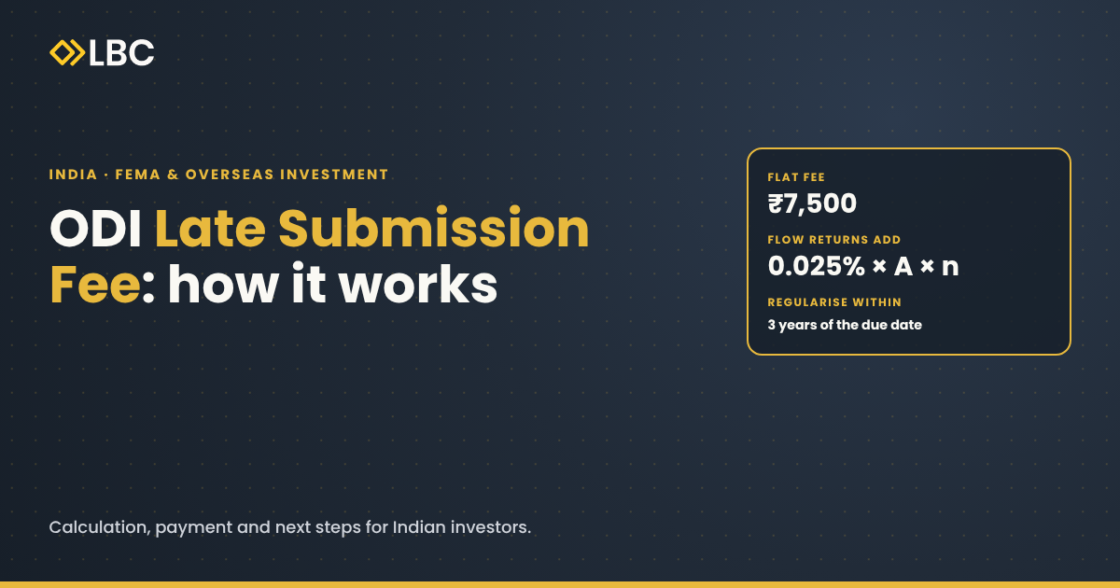
For flow returns such as Form FC and Form ODI Part I, the fee is a flat ₹7,500 plus 0.025% of the amount involved for every year of delay:
\text{LSF} = 7{,}500 + (0.025\% \times A \times n)
The notes to the matrix in the Master Direction set the rules for the two inputs and the final amount:
- A is the amount involved in the delayed reporting.
- n is the delay in years, rounded up to the nearest month and written to two decimal places. A delay of 8 months is 0.67 years.
- The fee is per return. Two late returns mean two fees.
- The cap: the total LSF cannot exceed 100% of A, and the result is rounded up to the nearest ₹100. The cap overrides the ₹7,500 base, so where A is very small the fee can fall well below ₹7,500, down to ₹100 when A is ₹100 or less.
- Row 1 returns (APR, FLA, Form OPI, evidence of investment) carry the flat ₹7,500 and no delay-based element.
The clock that matters: three years
The LSF option is open for three years from the due date of the reporting. After that, the late filing cannot be regularised through LSF and you would need to approach the RBI under the compounding route. Delays under the earlier FEMA 120/2004-RB regime get three years from the date the 2022 OI Regulations were notified.
Worked examples
The figures below are our own illustrations of the formula, with made-up amounts.
| Case | A | Delay | n | Working | LSF |
| Form FC filed late | ₹1,00,00,000 | 8 months | 0.67 | 7,500 + (0.00025 × 1,00,00,000 × 0.67) = 9,175 | ₹9,200 |
| Form ODI Part I filed late | ₹5,00,00,000 | 2 years 3 months | 2.25 | 7,500 + (0.00025 × 5,00,00,000 × 2.25) = 35,625 | ₹35,700 |
| APR filed 14 months late | not relevant | 14 months | not relevant | Flat fee | ₹7,500 |
| Very small flow return | ₹5,000 | 1 year | 1.00 | 7,500 + 1.25 = 7,501.25, above the cap | ₹5,000 |
Three lessons come out of these numbers. The delay-based part is small compared with the amount invested, so the cost of a late filing is usually modest. The fee grows with both the amount and the delay, so a large investment filed years late adds up. And the cap protects very small transactions, where 100% of A is lower than the ₹7,500 base.
How the fee grows with the delay
Because n is counted in months, you can read the fee off a simple table. The delay-based part is 0.025% of A for each year, so on ₹1 crore it adds ₹2,500 a year and on ₹10 crore it adds ₹25,000 a year. Figures are rounded up to the nearest ₹100.
| Delay | n | LSF on A of ₹1 crore | LSF on A of ₹10 crore |
| 3 months | 0.25 | ₹8,200 | ₹13,800 |
| 6 months | 0.50 | ₹8,800 | ₹20,000 |
| 12 months | 1.00 | ₹10,000 | ₹32,500 |
| 24 months | 2.00 | ₹12,500 | ₹57,500 |
| 36 months | 3.00 | ₹15,000 | ₹82,500 |
These apply to Row 2 (flow) returns. Row 1 returns stay at ₹7,500 whatever the delay.
Three common situations
Two APRs missed for the same foreign entity. Each year’s APR is a separate return, so the fee is 2 × ₹7,500 = ₹15,000. Missing the same year’s APR for two different entities gives the same total.
Form FC filed six months after the remittance, for ₹2 crore. n is 0.50. The fee is 7,500 + (0.00025 × 2,00,00,000 × 0.50) = ₹10,000.
A filing that is more than three years late. LSF is no longer available. The route is a compounding application to the RBI, which is dealt with in the comparison below.
The amount A is the amount involved in the return being filed late. Ask your AD bank how it reads A for each form before you budget, because the fee for a flow return depends on it.
How to pay and regularise, step by step
- List every delayed return. Check each foreign entity for Form FC, Form ODI Part I and III, evidence of investment, APR and FLA returns. Note the due date and the amount involved for each.
- Check the three-year window. Any filing still within three years of its due date can go the LSF route.
- Prepare the late filing. Gather the original documents and any CA certificates, such as the certified APR where the foreign entity is not statutorily audited. From 2 July 2026 the audit of the foreign entity must be by an auditor qualified in the host country.
- File through your designated AD bank. All overseas investment reporting goes through the AD bank. For a delayed report, the bank’s designated officer has to ratify it before it goes to the RBI.
- Receive the LSF advice. The RBI works out the fee and issues an advice.
- Pay within 30 days. Pay by demand draft in favour of the Reserve Bank of India, payable at the Regional Office that matches the prefix of your UIN (for example ND, WR, KA or CG for New Delhi, BG for Bengaluru, HY for Hyderabad). An advice not paid within 30 days becomes void, later payment is not accepted and a fresh application restarts the delay clock, so n gets larger.
- Confirm regularisation. Your AD bank cannot facilitate further remittances or financial commitments until the delay is regularised, so ask for written confirmation before you plan your next transfer.
Documents to keep ready
- The UIN and the original Form FC and Form ODI Part I filings
- Remittance advices and bank statements showing the dates and amounts
- Audited financial statements of the foreign entity, or the CA-certified statements where audit does not apply
- The auditor’s qualification evidence in the host country
- The shareholding and control position of each Indian investor in the foreign entity
- A table of every delayed return with its due date, filing date and amount involved
LSF or compounding: which route applies
| LSF | Compounding | |
| Covers | Delay in filing a required form, return or document | Contraventions of FEMA, including those that fall outside LSF |
| Time limit | Three years from the due date | Depends on the contravention, which must be eligible |
| Applied for through | The designated AD bank | An application to the RBI, filed physically or through the PRAVAAH portal |
| Cost | ₹7,500 flat, or ₹7,500 plus 0.025% × A × n | A non-refundable ₹10,000 application fee plus GST, then the amount set in the compounding order |
| Payment | Demand draft within 30 days of the advice | Within 15 days of the compounding order |
| Outcome | The delayed filing is regularised | A final compounding order that is not open to review |
A contravention that is serious, such as one involving money laundering, is not eligible for compounding at the RBI. A contravention that falls within three years of a previously compounded similar contravention is also ineligible. Check the K&S Partners’ guide to the RBI’s 2025 Master Directions on Compounding with your adviser before you apply.
Common mistakes and what happens if you do not pay
- Missing the 30-day payment window. The advice lapses and the delay clock restarts, which raises the fee on flow returns.
- Using the wrong amount for A. The fee is on the amount involved in that delayed return, not on your total investment in the entity.
- Treating LSF as a fix for everything. It covers reporting delays. A remittance made without the right approvals or outside the permitted limits needs compounding.
- Waiting past three years. The LSF option expires three years from the due date.
- Counting months loosely. The delay is rounded up to the next month. Day counts that fall just past a month boundary add to n.
- Ignoring the knock-on effect. Until the delay is regularised, your AD bank cannot facilitate new remittances or commitments for that investment.
If you neither file on time nor file with the LSF, penal action under FEMA, 1999 is possible. Filing and paying early is always the cheaper route.
How to avoid late filings in future
- Keep one compliance calendar for every foreign entity, with the Form FC date, the six-month evidence date, the 31 December APR date and the FLA return window.
- Tie each remittance to its filings the same day: Form FC and Form A-2 before the money moves, and a reminder for the evidence of investment.
- Ask the foreign entity for audited accounts early, and check the auditor is qualified in the host country.
- Review the AD bank’s pending items every quarter.
- Give one person in finance the ownership of the calendar, and one backup.
How Lapras helps
Lapras Business Consultants works with Indian investors on overseas investment compliance. We review every foreign entity for missing or late filings, calculate the LSF for each return, prepare the late filings with your AD bank, and keep a calendar so the next APR and FLA return go in on time. To talk through your position, write to us at info@lapras.in.
Frequently asked questions
Is the LSF a penalty? It is a fee for regularising a delay. It is separate from penalties and compounding for substantive contraventions.
What is the minimum LSF? The base is ₹7,500 per return, but the total can never exceed 100% of the amount involved, so on very small amounts it can be lower.
Is the fee charged per entity or per return? Per return. Several late returns for one entity each carry the fee.
How long do I have to pay? 30 days from the LSF advice. After that the advice is void.
Can I regularise a filing that is more than three years late? Not through LSF. The route is compounding with the RBI.
Does the flat ₹7,500 apply to the APR? Yes. The APR, FLA return, Form OPI and evidence of investment carry the flat fee.
Who calculates the fee, me or the RBI? Work out an estimate yourself with the formula, but the RBI issues the advice with the amount you must pay.
What if I pay after 30 days? The advice is void and the payment is not accepted. You have to apply again, and n is counted afresh, so the fee can be higher.
Do I pay once for several late returns? No. The fee is per return.
Is the APR needed if my stake is small? Not if you hold under 10% of the equity without control and have no financial commitment beyond that equity, or if the foreign entity is in liquidation.
Does the LSF hurt my ability to invest further? Until the delay is regularised, your AD bank cannot facilitate further remittances or financial commitments.
Can the LSF be below ₹7,500? Yes, but only on a flow return where the amount involved is small. The fee is capped at 100% of that amount and rounded up to the nearest ₹100, so it can be as low as ₹100.
This article is general information, not legal advice. Check the current RBI directions and your AD bank’s process before filing.